No identity tax
No password, phone number, email address, legal name, contact upload, ads, or public user directory is required to use degenerates.
Private messaging, end-to-end encrypted
Private messaging without the identity tax.
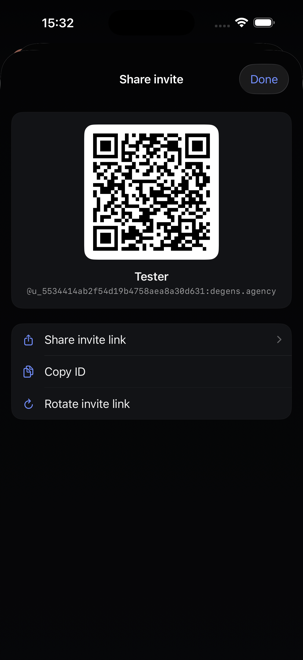
People should not have to trade phone numbers, contact books, ad profiles, or a permanent social graph just to talk. degenerates is passkey-only, end-to-end encrypted messaging built on the Matrix protocol, made for smaller rooms, QR contacts, and quieter conversations. There is no public directory and no username search: you reach people through invite links and QR codes.
Manifesto
The default social-app bargain is broken: give up identity, contacts, and attention for the right to communicate. degenerates starts from the opposite premise. Every person deserves private coordination on their own terms: intentional discovery, opaque accounts, and end-to-end encrypted chats, with encrypted messages and selected attachments the server stores as ciphertext it cannot read.
No password, phone number, email address, legal name, contact upload, ads, or public user directory is required to use degenerates.
Accounts use opaque Matrix IDs and user-chosen display names. Contacts are built from direct chats, invite links, QR scans, or exact IDs that people choose to share.
The app uses the Matrix protocol for rooms, sync, media, and push routing. It provides end-to-end encrypted chats, with encrypted messages and selected attachments. It runs on a homeserver we operate and does not federate with other Matrix servers today, so nobody outside degenerates can join a room.
Direction
The hosted app is the first useful path, not the end state. None of what follows has shipped yet — it is where the work is headed, roughly in this order.
An OpenClaw integration on the Matrix protocol. The agent joins an encrypted room as a visibly marked member, and its runner can read the messages it is given keys for — that is the trust boundary today. The direction is to erase it: the model itself open-weight, on hardware you own, encryption running user to model. Full data sovereignty.
One homeserver today, ours. Federation is where this goes: degenerates servers talking to each other over the open Matrix protocol, so the network stops depending on any single operator — including us.
Product work flows through public code, tests, docs, and contribution paths before the hosted overlay deploys it. The hosted app becomes one deployment of a public project, not the project itself.
The security model
You sign in with a passkey — no password to phish, no phone number to leak; your account is a Matrix ID, and the passkey is its trust root. Rooms are end-to-end encrypted by default. Encrypted history recovery is best-effort, through a key derived from that same passkey: history from before backup was enabled, or keys that never reached backup, can be lost for good — and losing the passkey can mean losing them too. In-app device verification ships later, so today an encrypted room proves the room, not the person. The privacy policy has the full picture.